The Hallway Bulb, and the Night Light That Comes After It
The job took four minutes. The month before it is the part worth writing down.
The call
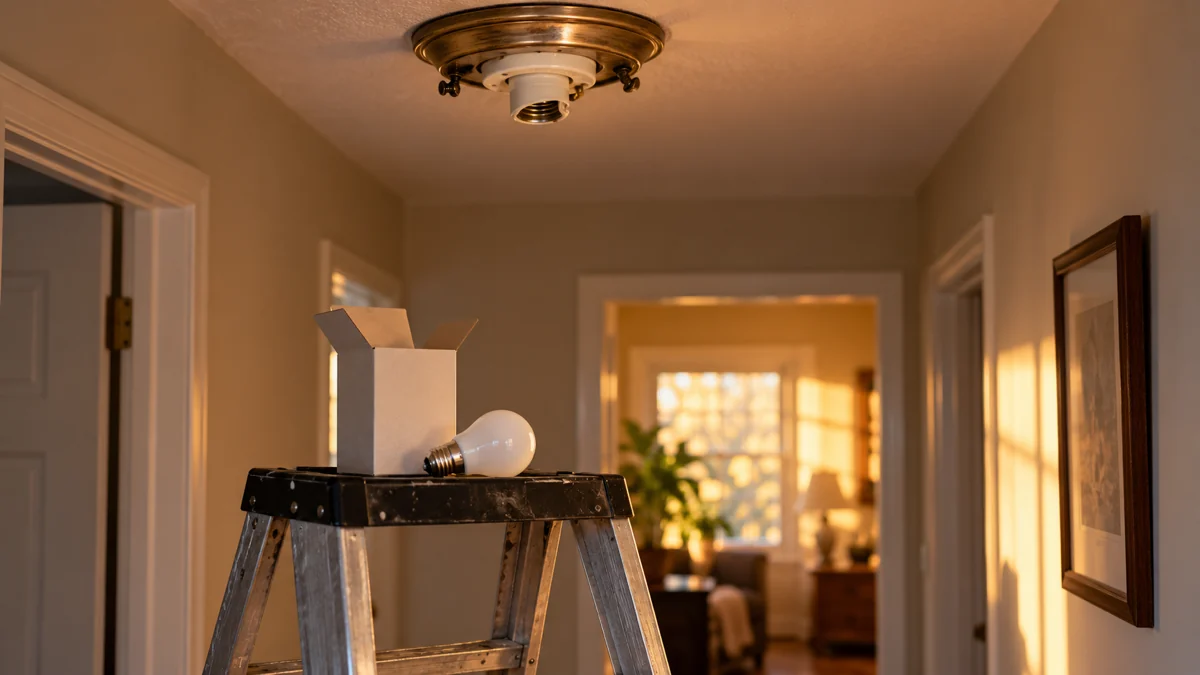
The man on the phone said the hallway light had gone and that he would appreciate it if I brought my own ladder. I asked how long it had been out. He thought about it and said a month, maybe a little more. He had a stepladder of his own in the garage; he did not say why he had not used it, and I did not ask. Some men stop climbing things at a certain point and do not announce it.
The hallway ran from the front door to the bedrooms, with the bathroom halfway along. For a month the family had crossed it by the glow of whatever room was lit at either end. He had got used to it, he said. His wife had not.
The job
Power off at the switch, then at the breaker, because an old fixture can surprise you.
Shade off, bulb out, the socket checked for scorching and loose contact. It was clean.
New bulb in, a warm one rather than the cold blue he had in the box, because this was a hallway crossed at night and not a workshop.
Shade back, breaker on, switch on. Four minutes, as I said.
Then the thing that made the call worth a slip. Before I folded the ladder he asked, a little sideways, whether I had one of those small lights that plug into a wall socket. The night light kind. He had been getting up in the dark, he said, and twice he had put a hand on the wall where the bathroom door was not. I had two in the van. I put one in the socket outside the bathroom and one at the bedroom end, both low, both the dim amber kind.
The habit
Here is what I have noticed in houses, and what I do in my own. A man who has lived with a dead hallway bulb for a month has usually also been living in a house that is either fully lit or fully dark, with nothing in between. The kitchen overhead blazes until he goes to bed, and then everything is switched off at once, and then at some hour of the night he is up and feeling for a wall.
Research has looked at how the body reads light late in the day, and the plain version is that bright light in the last hour or two before bed tends to tell the body it is still afternoon. Some men notice they fall asleep more easily on evenings when the house gets dimmer in stages: the overhead off, a lamp on, the lamp off, a night light left. It fixes nothing by itself and it is not a rule. It is a setting on the house.
So the habit, if you want one, is to give the house an evening and not just a day and a night. Pick one lamp in the room where you sit after dinner and make it the only light on for the last hour. Put a dim amber night light in the hallway socket nearest the bathroom and leave it on, every night, so the trip at three in the morning does not need the big light and does not need a hand on the wall. In the morning, do the reverse: curtains open before coffee, because the same body that reads dim light as evening reads a bright window as a start.
None of that needed a handyman. The bulb did, or he thought it did. If the ladder is the part you have been avoiding, that is a fair thing to admit and a fair reason to call someone. If the dark is the part you have been getting used to, that is worth more than four minutes of thought.
What I left on the counter
The old bulb, in the new bulb's box, so he could see the kind to buy next time.
A note with the fixture's maximum wattage, written on the box, because the previous bulb had been over it.
The second night light, in its packaging, for whichever socket turned out to matter.
This slip is about a light fixture and the way a house is lit. If sleep, night-time trips to the bathroom or anything in your body is on your mind, that is a conversation for your doctor, and a dim bulb is not a remedy for it.