The Step That Creaks, and What the Staircase Knows About You
The fourth tread from the bottom had been announcing him to the whole house for a year. He wanted it quiet. I wanted to know why it had taken a year.
The call
A creaking step is the kind of repair people put off because it is not broken. The stair still holds. It just talks. This one talked loudly enough that the man of the house had started skipping it, stepping from the third tread to the fifth, which is a long stride for a man of any age and a strange thing to do in your own home for twelve months.
He told me that on the way in, half as a joke. He also said the skip had been getting harder, which was not a joke, and which is the sentence this slip is really about.
The job
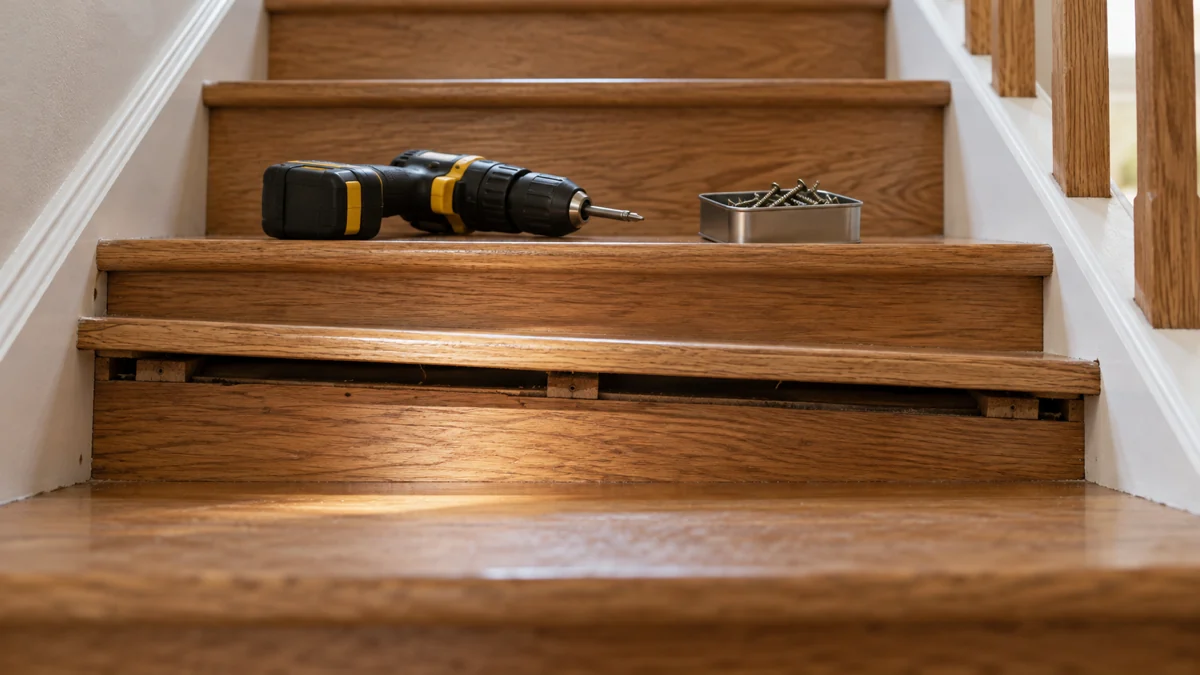
Found the noise by standing on each corner of the tread in turn. It was the front left, where the tread had worked loose from the stringer underneath.
Two long screws driven at an angle through the tread into the stringer, heads sunk just below the surface, holes filled with a wax stick the color of the wood.
A thin line of carpenter's glue worked into the gap where the riser meets the tread, then a bead of pressure from my own weight while it set.
Walked the whole flight twice, up and down, to be sure the fourth was the only one. The seventh had an opinion too, so it got the same.
Forty minutes, most of it listening. The stairs were quiet when I left, and he walked up them the normal way, one tread after the other, which I think he had forgotten was an option.
The habit
A staircase is the most honest instrument in a house. The bathroom scale can be stepped on in the morning after a bad night and argued with. The stairs cannot be argued with. Either you took them one at a time with a hand free, or you took them with a hand on the rail and a pause at the turn, and the difference is something the body knows before the man does.
Some men notice that the flight of stairs tells them more about their week than any number does. The morning after a heavy weekend it is a longer climb. The week they walked to the store instead of driving, it is shorter. Research has looked at stair climbing as a plain, everyday measure of how a body is doing, and the appeal of it is that nobody has to buy anything or wear anything. The stairs are already there.
So the habit is to stop skipping the step, in every sense. Take the stairs in your own house the normal way, every tread, and pay attention once a day to how that felt. If it felt like more than it used to, that is worth saying out loud to someone, starting with your doctor, long before it becomes a reason to move the bedroom downstairs. And if there is a staircase anywhere in your day that you could take instead of the elevator, take it once, on purpose, and see what the fourth tread has to say about it.
One more thing from that house. He carried the laundry basket up those stairs with both arms around it and no hand for the rail. I suggested two smaller loads and a free hand. He laughed, and then he did it that way while I was packing up. Small loads, more trips, one hand free: that is not advice about health, it is advice about stairs, and it happens to be the same advice.
What I left on the counter
The wax stick, so the next sunk screw head on any piece of wood in the house can be filled by him.
A note that the handrail bracket at the turn was loose, and that I would come back for it or he could do it with the same screws.
Nothing else. A creaking step is a cheap job, and I would rather be called back for the rail than paid twice for the tread.
This slip is about a stair tread and the plain act of climbing it. If stairs have been getting harder, or your knees, breath or balance come to mind when you read this, that belongs in front of your doctor. A handyman fixes the step, not the climb.